PROBIOTICS: LIVE STRAIN EFFICACY.
Viability metrics for active cultures.
Live Strain Dynamics
The definition demands viability. CFUs (Colony Forming Units) at time of manufacture are irrelevant; CFUs at end of shelf life dictate efficacy. Gastric transit survival is the primary bottleneck. Unprotected vegetative cells often suffer 99% mortality at pH 2.0 within 30 minutes (Wallace et al., 2022).
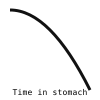
Viability Bottlenecks
| Challenge | Mortality Rate (Unprotected) | Engineered Solution |
|---|---|---|
| Gastric Acid (pH 2.0) | > 95% in 45m | Enteric Alginate Coating |
| Bile Salts (Duodenum) | ~ 60% | Bile Salt Hydrolase (BSH) Expression |
Tool: Survival Rate Calculator
Common Mistakes in Live Strain Administration
- Purchasing based solely on high CFU counts (e.g., "100 Billion") without verifying strain-level clinical data.
- Storing freeze-dried strains improperly, exposing them to moisture which rapidly breaks dormancy and causes cell death prior to ingestion.
FAQ Section
Should probiotics be taken with food?
Generally, yes. Food buffers gastric acid, raising pH and significantly increasing survival rates compared to taking them on an empty stomach. Review general FAQs for specific dosing regimens.
Are live strains always better than dead ones?
No. In many immunomodulatory applications, postbiotics (inanimate cells) demonstrate superior stability and comparable efficacy.